
Family Mediator / Book Consultation
Book a Family Mediation Consultation by Phone
Call to enquire about an initial discussion or a MIAM. First understand the process, suitability and practical details; an appointment is agreed separately.
An enquiry is the starting point.
You do not need to prepare a complete case before making contact. A short explanation of what you need help with can be enough to begin asking about the process.
This website does not select a time, take payment or confirm a booking. Call 0330 010 0028 to enquire; any appointment, charge and service arrangements need to be discussed and agreed.
Start simply
Decide what you want from the first call
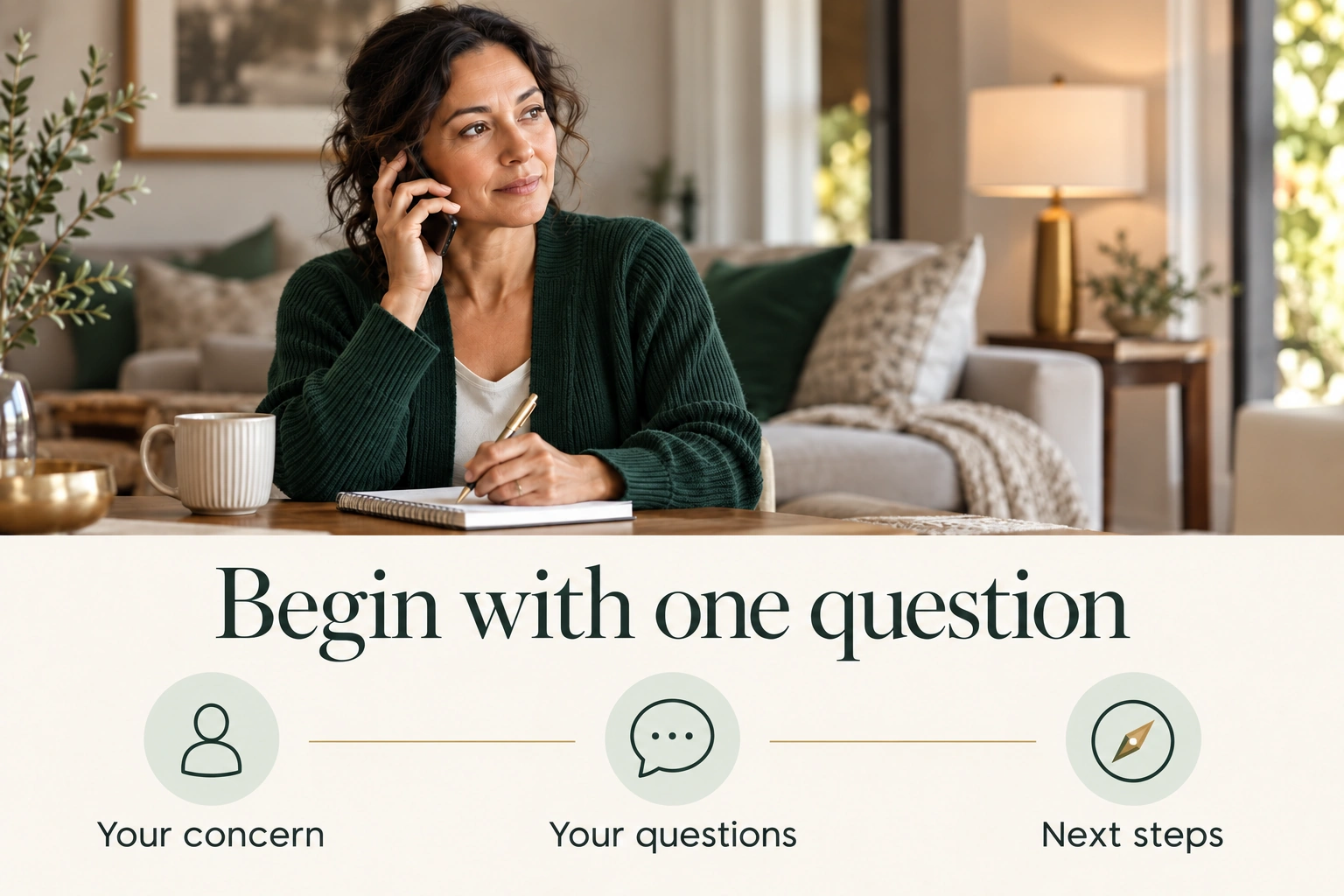
Before calling, it can help to finish one sentence: “I would like to understand…” Your answer might concern a MIAM, a parenting disagreement, financial discussions or whether mediation is suitable at all. A clear opening makes it easier to ask about the right next step without recounting the whole history immediately.
You may be calling for yourself or seeking general information before someone else makes their own enquiry. Be clear about that distinction. An enquiry from a relative or friend should not be treated as consent for an adult to participate or permission to disclose someone else’s personal information.
If you have received court paperwork or advice about a MIAM, say so and note any date that matters. A deadline is relevant context, but an enquiry does not extend it or fulfil a procedural requirement. A legal adviser can explain what must happen and whether an exemption or another step applies in your circumstances.
You can ask how initial assessment works, what information is needed and how an appointment would be agreed. It is also reasonable to ask whether the service can address the type of issue you have in mind. Describing a question does not commit you to mediation or require you to accept a proposed appointment.
Safe communication should be discussed before routine arrangements are made. If someone else can access your device, call history or messages, consider what contact is safe and raise that concern. Do not assume that a request for contact can be handled safely without explaining the limitation.
Keep the first call focused on what is needed to identify the next step. Sensitive records, account details and extensive allegations are usually not necessary to ask about the process. If documents are needed later, ask how they should be provided rather than trying to send them to a telephone number.
A simple opening for an uncertain situation
You might begin by explaining that you are separating and want to understand how to discuss a child’s routine, or that you have been advised to consider a MIAM and do not know what it involves. These are examples of the kind of opening that identifies the question without making assumptions about eligibility, availability or the other person’s willingness.
If you become upset or lose your train of thought, return to your short list. You can ask for an explanation to be repeated or note a question for a later discussion. An enquiry does not need to be a polished account, and the order in which you explain a concern does not determine its importance.
It can also help to identify what you are not yet ready to discuss in detail. You may need general process information before sharing personal circumstances, or may first need to establish a safe way to communicate. State that boundary clearly. The useful first step is to understand what information is needed for the next stage, rather than feel obliged to disclose everything during the opening call.
If you are unsure what to ask first, begin with the difference between the steps being described. Ask whether the next conversation would be a general enquiry, an individual assessment or a joint session. Then clarify what would be required before that step could take place. This can make a complex situation feel more manageable without suggesting that the underlying decisions are simple.
Before ending the call, check whether there is an action for you to take and how you will recognise that it has been completed. You should not have to guess whether someone is waiting for information or whether an appointment remains only a possibility.
What a MIAM is for
Understand the role of an initial assessment

MIAM stands for Mediation Information and Assessment Meeting. It is a meeting in which mediation is explained and suitability is considered. It can help someone understand how a discussion might work, identify concerns and consider other options before deciding whether to proceed.
An assessment is not the same as a joint mediation session. It should provide an opportunity to discuss circumstances individually, including matters that would be difficult or unsafe to raise in front of the other person. Ask how that individual conversation is arranged and what its confidentiality boundaries are.
You may want to understand the mediator’s role, how topics are selected and what happens if someone does not wish to take part. You can also ask about the distinction between mediation information and individual legal advice. The assessment should help you evaluate a process rather than pressure you towards a predetermined decision.
For many family court applications in England and Wales, a MIAM is normally required before applying unless an exemption applies. That does not mean every person or every application has the same requirement. If you need evidence of attendance for a particular application, explain that when enquiring and seek legal advice about the current requirements.
Safety, pressure and the ability to negotiate freely are relevant even when both people say they want to try mediation. A suitable format cannot be assumed simply because a meeting can take place remotely or in separate rooms. Raise concerns directly and ask how they will be assessed.
After an assessment, possible next steps may include further information, joint mediation if suitable, independent advice or a different route. Attendance does not oblige you to agree with the other person, nor does it guarantee that mediation will be offered or appropriate. Ask what any suggested next step would involve before accepting it.
Questions that help distinguish the stages
Ask what would be covered in the proposed initial meeting and what would be left for a later session. If you are unfamiliar with mediation, the distinction can be easy to miss. A meeting to explain and assess the process is not an occasion on which you must negotiate every disputed issue with the other person.
You can ask how an invitation to another participant would be handled, whether the initial conversation is individual and what information may need to be recorded. Clarify what would be disclosed and to whom. An expectation of privacy should be based on an explanation of the service arrangements rather than a general assumption that every aspect of mediation is confidential in the same way.
If the assessment suggests another route, ask what that means in practical terms. You may need advice from a solicitor or another appropriate professional. Do not assume that a suggestion automatically creates a referral or an appointment elsewhere. Understanding who is responsible for taking each next step can prevent a useful conversation from ending with both sides expecting someone else to act.
Before the conversation
Prepare a useful working note

Preparation should make the conversation easier to use. Start with three headings: what needs a decision, what you need to understand and what makes participation difficult. Under each, write a few practical points in everyday language. You do not need to present a legal argument to ask about mediation.
For parenting questions, note the present routine and one or two examples of what is not working. A disagreement about communication may be easier to explain through a missed school message than through a general statement that nothing is ever shared. Avoid asking children to prepare accounts or choose an outcome for an adult meeting.
For financial questions, identify broad areas such as housing, income, debts or pensions. You can ask which records may be useful later. Do not spend time compiling a full disclosure package for an initial enquiry unless you have been asked to do so through an appropriate process.
Keep important dates separate from your wider notes. They might include a court date, a move, a school transition or a deadline given by an adviser. Explain which dates are fixed and which are only expected. Uncertainty about a date is useful information and should not be disguised as certainty.
Make a short list of questions about the service. You may wish to ask about charges, format, the expected scope of an initial meeting, cancellation arrangements, access needs and how concerns can be raised. Writing them down can help if the subject is emotionally difficult or the conversation covers unfamiliar information.
Preparation does not require contacting the other person first. In some situations that may be inappropriate or unsafe. Ask how any invitation would be handled rather than making assumptions. If you already have a solicitor or other adviser, consider which questions belong with them so that you can use each conversation for its proper purpose.
Separate the background from the decision
The history of a disagreement may help explain why a topic is difficult, but preparation can become overwhelming if it attempts to document every past exchange. Keep your working note focused on the decision that needs attention and the information needed to discuss it. A longer chronology can remain separate if a professional later asks for it.
For each priority, add one concrete example. A difficulty with handovers might involve a particular journey or a repeated change of time. A financial concern might involve uncertainty about an account balance or the cost of maintaining two homes. An example should clarify the practical question, not be treated as proof of every aspect of a wider dispute.
Finally, mark which points need private discussion. Safety, safe contact and pressure about participation should not be buried in a general list of agenda items. You can say that you have an issue to raise individually without putting its detail into a document that others may see. Ask how that conversation can be arranged before assuming that a shared meeting is the right place to explain it.
Privacy and access
Discuss a setting in which you can participate

A useful meeting requires more than an available time. Consider whether you can hear clearly, speak without being overheard and read or take notes comfortably. If a proposed arrangement makes those tasks difficult, raise the issue before the meeting rather than trying to manage it silently throughout.
For a remote format, ask what equipment and connection would be needed and how the meeting would be accessed. A private room matters: another person may be out of camera view yet still able to hear or influence the conversation. A public place, a shared device or a car with other people nearby may not provide suitable privacy.
If in-person attendance is being discussed, ask for the practical details needed to consider it. Do not infer an office location or accessibility feature from a general website description. Travel, arrival arrangements and any access requirement need to be understood before you commit.
Tell the service about a communication need, disability, language requirement or difficulty with a proposed format. Possible adjustments should be discussed specifically. An interpreter, a support person or specialist child involvement should never be assumed to be available or appropriate without agreement about their role and confidentiality.
Safety concerns deserve a separate conversation from ordinary preferences about convenience. Ask how you can raise concerns privately and what happens if circumstances change. Separate-room working or remote access may be considered in some cases, but it is not a blanket answer to coercion, intimidation or risk.
You can also ask how breaks, technical problems and interruptions would be handled. Knowing what to do if a connection drops or someone enters the room can reduce uncertainty. These are practical matters to clarify, not reasons to assume a particular service format is guaranteed.
Think about the whole appointment
When considering a time, allow for the circumstances around the meeting as well as the meeting itself. A conversation immediately before a school collection or work shift may leave little room to read information or recover concentration. Ask about the expected duration before deciding whether a proposed time is practical for you.
For a remote conversation, consider whether children or other adults may enter the space and whether headphones would provide adequate privacy. Headphones can stop another person hearing the speaker but do not stop them hearing you. If the setting is not private enough, raise that limitation rather than rely on a technical device to solve it.
Ask what you should do if you need a break, cannot hear properly or lose access to the meeting. Knowing the agreed way to report an interruption helps avoid confusion about whether someone has chosen to leave. If a difficulty affects meaningful participation, it may be necessary to reconsider the format or timing. Confirm the practical arrangement rather than assume that simply connecting to a meeting makes the setting suitable.
Before agreeing a time
Clarify charges and appointment arrangements

Ask what the proposed appointment includes and whether a charge applies. It is useful to distinguish the cost of an initial assessment from any later mediation, preparation or written work. Do not assume that one quoted amount covers the entire process or that a fee mentioned elsewhere applies to your circumstances.
If a charge is proposed, ask for the amount, what it covers, when payment would be due and whether any additional work could incur a separate charge. You can ask for the information in a form you can read and retain. A clear quotation helps you decide whether to proceed without having to infer missing terms.
Ask what happens if you need to cancel, rearrange or stop. The relevant arrangements should be explained before a commitment is made. The terms that apply to your proposed service should be clear before you accept it.
Funding or reduced-cost support can depend on eligibility, the provider and the work involved. If cost is a concern, ask what may be available and what evidence would be needed. Nothing on this page promises a grant, legal aid arrangement or free appointment with Family Mediator.
An appointment should be understood in practical terms as well: who it is with, its purpose, the agreed format and how to access it. Ask how confirmation is provided and what to do if you cannot find it. Calling a number, opening this page or clicking an enquiry link does not reserve a slot.
Keep legal deadlines separate from appointment administration. If an appointment cannot take place before a date that matters, seek advice about the deadline rather than assuming the enquiry protects your position. A clear understanding of both the service and your legal obligations helps avoid an avoidable misunderstanding.
Keep a clear record of what was offered
Write down the service being discussed and the questions you still need answered. If information is provided in writing, check that it matches your understanding of the conversation. A quotation for one person’s assessment should not be assumed to cover both participants or every later session unless that has been expressly explained.
Ask whether charges relate to time, a particular meeting, preparation or a document. Where more than one person is involved, clarify how payment responsibilities are arranged without assuming that one person is agreeing on behalf of the other. Each participant should understand the commitment relevant to them.
If you are unsure about cancellation or a possible change, raise it before accepting the appointment. You may need to know how notice is given, which terms apply and how any statutory rights interact with the proposed arrangements. Do not infer those details from a generic description of mediation. Clear information before commitment is more useful than trying to resolve a different understanding after a time has been reserved or work has begun.
Your next step
Know what you are choosing after the meeting

At the end of an initial discussion, check what has actually been decided. You may have received information, identified questions for an adviser or been invited to consider a further step. Ask for clarification if you are unsure whether something is a suggestion, an offer or an arrangement you have accepted.
If joint mediation is proposed, understand its scope and the agreement to mediate before proceeding. Relevant topics include the mediator’s role, confidentiality and its exceptions, how information is shared, charges and how a participant can raise a concern. Those details belong in the arrangements for the service, rather than being guessed from a general introduction.
Take time to consider anything you do not understand. You may want independent legal advice before discussing a particular financial proposal or before signing a document with legal consequences. Mediation does not remove the value of advice that focuses on your own position.
You may also decide that the process is not right for you. A decision not to continue can follow a suitability concern, a need for another form of help or a change in circumstances. You should not treat attendance at an initial meeting as an obligation to accept an arrangement that you cannot make freely.
If further information is requested, ask what is needed, why it matters and how to provide it. Make sure a summary does not turn an estimate into an agreed figure or a possible idea into a final decision. Keep a note of tasks and responsibilities so that the next step is understandable.
To begin, call 0330 010 0028. If you would prefer to understand the principles first, read about our approach. The aim of the first step is clarity about the process and your choices, not a promise that every disagreement can be resolved.
Review what you have learned
After an initial conversation, compare the information with the questions you wrote beforehand. Which points are now clear? Which need an individual assessment or independent advice? You may discover that the next useful step is smaller than you expected, such as checking a deadline or finding a document rather than agreeing to a course of meetings.
If a summary is provided, read it while the discussion is still fresh. Identify anything that does not reflect what you said or understood. A specific correction is more helpful than a general statement that a record feels wrong. Ask how an unresolved difference about the wording can be noted, especially where another participant’s account is involved.
Keep the distinction between choosing a process and choosing an outcome. Being willing to explore mediation does not mean accepting a proposed parenting arrangement, financial settlement or account of past events. Likewise, an initial decision not to proceed does not resolve the underlying legal questions. Seek appropriate advice about those questions and any continuing responsibilities so that the next step rests on an accurate understanding of your position.
A little more clarity
Questions you may have.
Can I select an appointment time on this website?
No. This is a telephone enquiry route. A time, format and any charge must be discussed and agreed separately.
Do I need to speak to the other person before calling?
You can ask for general information yourself. Raise safety and contact concerns before any invitation or communication with another participant is considered.
Will I have to describe the whole relationship?
An initial enquiry can focus on the type of help you are seeking. Share sensitive detail only when it is needed in the appropriate private conversation.
Is an initial assessment a promise of joint mediation?
No. Suitability needs to be considered, and the process may not be appropriate. Attending an assessment does not require you to continue.
Can I ask someone to help me prepare?
You can seek support with your own notes and questions. Ask separately about whether anyone may attend a meeting and what boundaries would apply.
What if I need urgent protection or have a deadline?
Seek appropriate urgent help or independent legal advice. An enquiry does not provide protection, stop proceedings or extend a deadline.
The conversation ahead
Begin with what you need to understand.
Ask about the process and the practical next step for your circumstances.